
Building a Culture of Problem Solving
In my last article, we talked about recurring problems, root causes, and the 5 Why technique. But what happens when the problem is too big or too complex for a simple 5 Why exercise?
Sometimes, you need a bigger tool.
If the Problem Is Huge, You May Need a Tool
Fishbone diagrams are used on complex problems with many contributing factors. You draw a diagram that has 6 categories, then you brainstorm what contributes to the problem within the categories.
The categories I use are:
Personnel
Processes
Machines/Equipment
Materials
Mother Nature
Measurables
Employee turnover is a great example. I have facilitated root cause workshops where this problem is chosen to break down. There will often be 30-50 things that contribute in some way to this issue.
Some big, some small.
Some easy to change, some that you can't move the needle much on.
Once you break the big problem into smaller ones, prioritize what you want to fix, then do 5 Why to find the root cause.
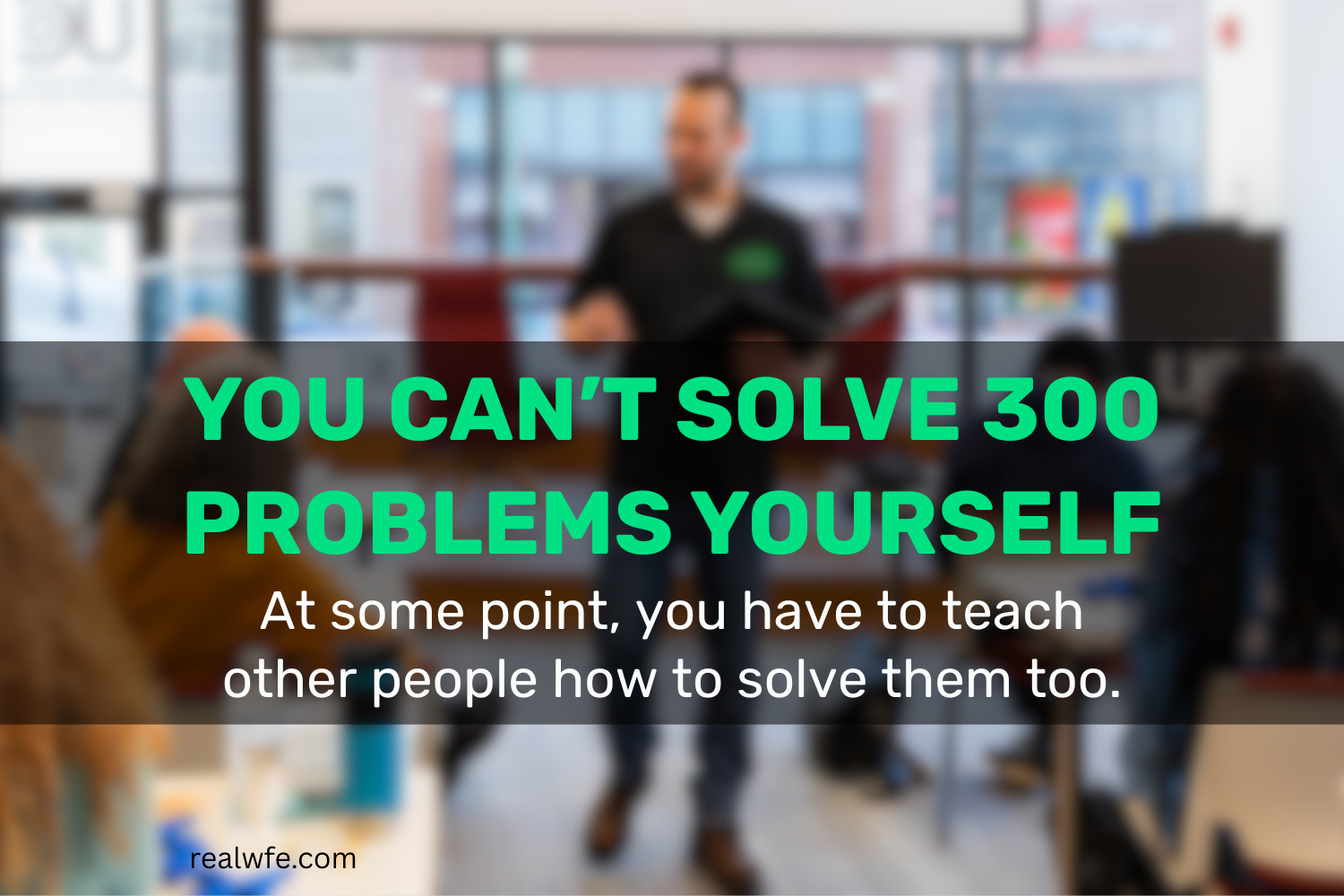
If There Are 300 Problems, You Can't Solve Them Alone
Ok... maybe 300 is excessive, but you get the point.
Many businesses I work with have problem solvers in busy management positions. This adds to the feeling that you are always putting out fires.
More than likely, you have team members that are capable of solving problems. So what is their barrier?
Most times, it can boil down to two things:
They don't feel like they have the power to make the changes necessary to solve issues independently.
They don't know any techniques to solve a problem with no obvious solution.
So how can we break down those barriers?
Take the Time to Teach Them
Obviously, I do this for a living and would love to help you.
But... I can already hear marketing yelling at me... you can do it yourself!
If your business has a process and techniques to solve problems, schedule training to teach everyone how to solve problems.
Will everyone be amazing problem solvers?
No.
But you will end up with a crew that can solve varying levels of problems.
Now, empower them to make decisions within their realm.
You will start seeing fewer fires, everyone will gain back some time, and you'll see buy-in from your team increase.
That's how a culture of problem solving begins.
About the Author
Randy Kowalczyk is the owner of Real Workforce Evolution, where he works with organizations to improve how work gets done and how leaders lead.
Real Workforce Evolution provides practical coaching, training, and facilitation in continuous improvement, leadership development, and structured problem solving. The focus is on helping teams build systems and behaviors that last, not quick fixes that fade.
Randy partners with organizations across West Virginia, Ohio, and Pennsylvania, working alongside leaders and teams to turn ideas into action and make improvement a habit.